
Orquesta Akokán
Bio
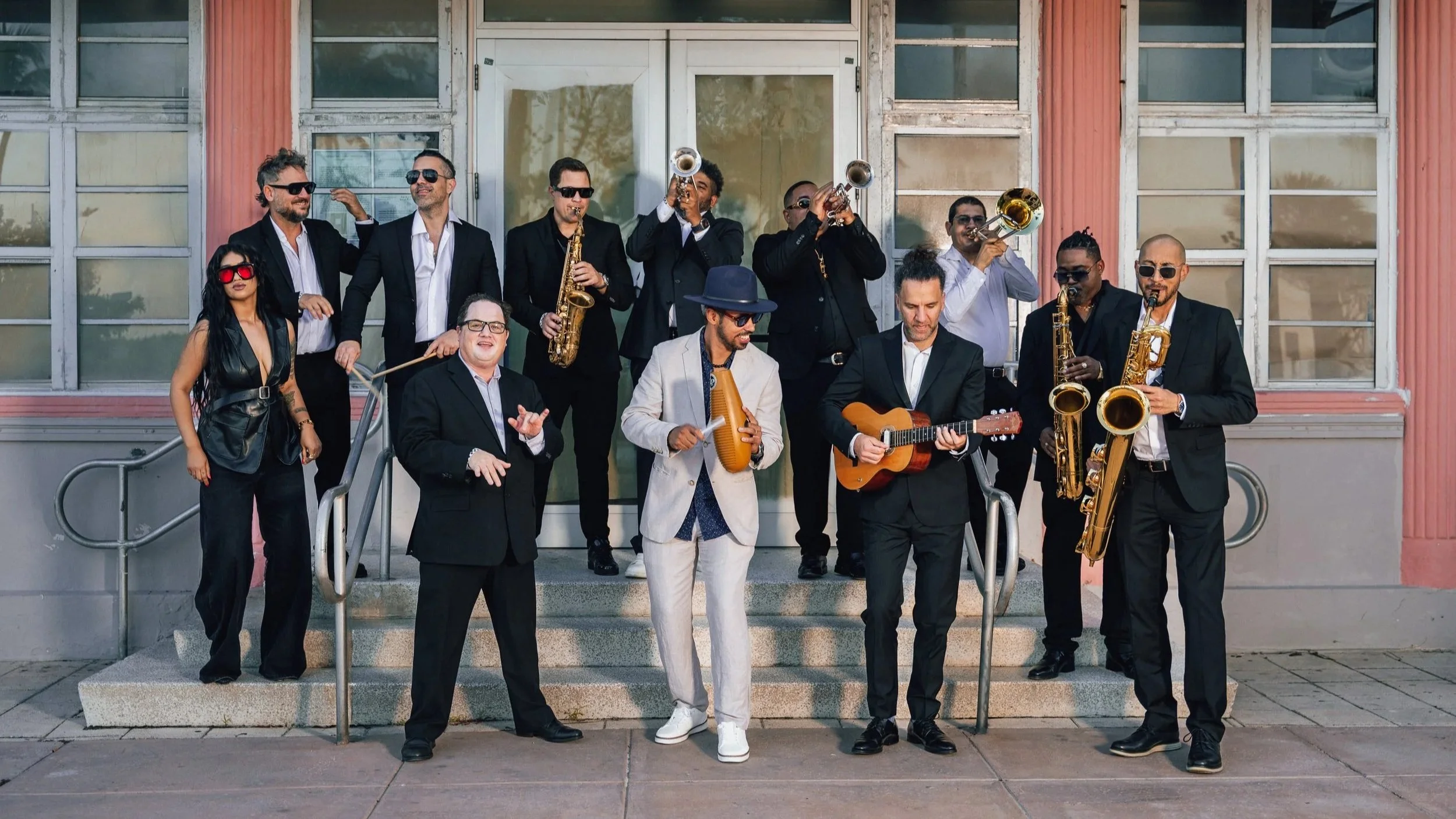
Orquesta Akokán derives its name from a Yoruba word meaning "from the heart." Across a decade of acclaimed, Havana-recorded releases led by Chulo Records producer Jacob Plasse and pianist-arranger Michael Eckroth, the group stays true to that sentiment.
Formed with a brilliant cross-section of players from legendary Cuban bands like Los Van Van and Irakere, the ensemble debuted on Daptone Records in 2018, polishing the golden mambo of Pérez Prado and Benny Moré to a 21st-century sheen—earning a Grammy nomination for “Best Tropical Latin Album.” Subsequent releases expanded this vision at Cuba's storied Egrem and Abdala studios: 2021’s 16 Rayos pushed mambo’s hallowed boundaries into avant-garde territory, while 2024’s Caracoles wove Congolese spiritual dialect into groove-saturated rhythms, accumulating Billboard Latin Music, Telemundo, and Songlines awards along the way.
América!, however, invites a different journey.
"I wanted something more intimate, more inward," Plasse reflects. "Our past albums have been very 'capital-M Mambo' — fast tempos, strident horns. For this, I thought we could explore something new." Plasse gave each collaborating vocalist and lyricist a single phrase: "América, I am here. I said goodbye to the things I loved and dreaming left into a new life. ¿De quién me despedí y qué soñé?" (Who did I say goodbye to, and what was I dreaming about?)
From that starting point, the lyricists moved in different directions. Kiko Ruiz took a lighter, danceable approach anchored in the sweet cadences of the cha-cha-cha. Carolina Oliveros and Miriam Elhajli turned toward loss and the weight of leaving home, into all its unresolved contradictions.
Oliveros — the Colombian vocalist who fronts alt-Latin outfit Combo Chimbita — wrote one of her songs, "No Me Voy," under the inspiration of Celia Cruz and Cruz's unfulfilled longing to return to her homeland and sing on its soil. Though Oliveros can return to Colombia, each visit is different, she says: "The streets change, the smell changes. Your family changes. The years pass and you feel it in everything." And every departure carries its own particular uncertainty.
Miriam Elhajli, Venezuelan-Moroccan singer and ethnomusicologist, brings an equally restless perspective. Having spent years researching early 20th-century music from Venezuela, Colombia, and Paraguay, she describes one of her four songs on the album, "Aprendizaje," as tracing the movement toward and away from everything we know — what is sacrificed, lost, and gained in that motion. It evokes the void that comes from any goodbye: to a family member, a country, a landscape, even an illusion. "Aprendizaje" moves slowly, lushly, with a quality that feels almost ancient — Middle Eastern and Cuban at once. Elhajli's voice swells and breaks across it, embodying her sense that the void is paradoxically a space of resonance, a hollow you can sing into as a way of surviving and overcoming loss.
América! maps how Cuban music became the rhythmic backbone of an entire hemisphere, a point Mireya Ramos makes tangible. The bandleader of Mariachi ensemble Flor de Toloache lends potent, velvety vocals to "Cha Cha Cha Ooh La La" and is unequivocal: this music is also a celebration — one of thousands of ways, as Ramos puts it, that Latinidad expresses itself to the world.
At the same time, the political reality behind the music is impossible to ignore. The band has undergone the dislocation of many of its former members: the younger Havana musicians who played on the early albums have since defected from the island, while the older players remain in Cuba but cannot travel. América! finds rich consolation in the inclusion of virtuosic saxophonist, bandleader, and composer Roman Filiú. From Santiago de Cuba, Filiú steps in on alto saxophone, bringing with him a profound knowledge of son and soul. His direct connection to the great lineage of Cuban giants lives in every phrase he plays. "When he takes a solo," arranger Michael Eckroth says, "you can hear the history" — exactly the kind of living continuity Orquesta Akokán has always honored.
Unlike their previous recordings, tracked mostly in Havana, Cuba, the América! sessions were cut live to tape at Penrose Recorders in Riverside, California. Built entirely around vintage equipment from the 1940s and '50s, Gabe Roth’s facility provided an indispensable backdrop for Orquesta Akokán.There is a striking unexpectedness to it—Havana's golden era sound captured not in Cuba, but in California.
After years of proving their fidelity to an era, Orquesta Akokán has taken the time to create something more expansive. América! reminds us that this music — so often compartmentalized as "Latin" or "Cuban" — has always belonged to a broader hemispheric conversation, shaped by American jazz, migration and diasporic memories.
América! reaches beyond a storied Havana past into a present defined by oceans traversed, arrivals and goodbyes, and horizons still becoming. You hear all of it in the ache just beneath the melodies, in the irresistible sway the music insists on even at its most melancholy. And in that knowledge — from all these perspectives and distances — the landscapes make infinite sense.